Why Bengaluru Businesses Need an AEO & GEO Strategy in 2026 (Not Just SEO)
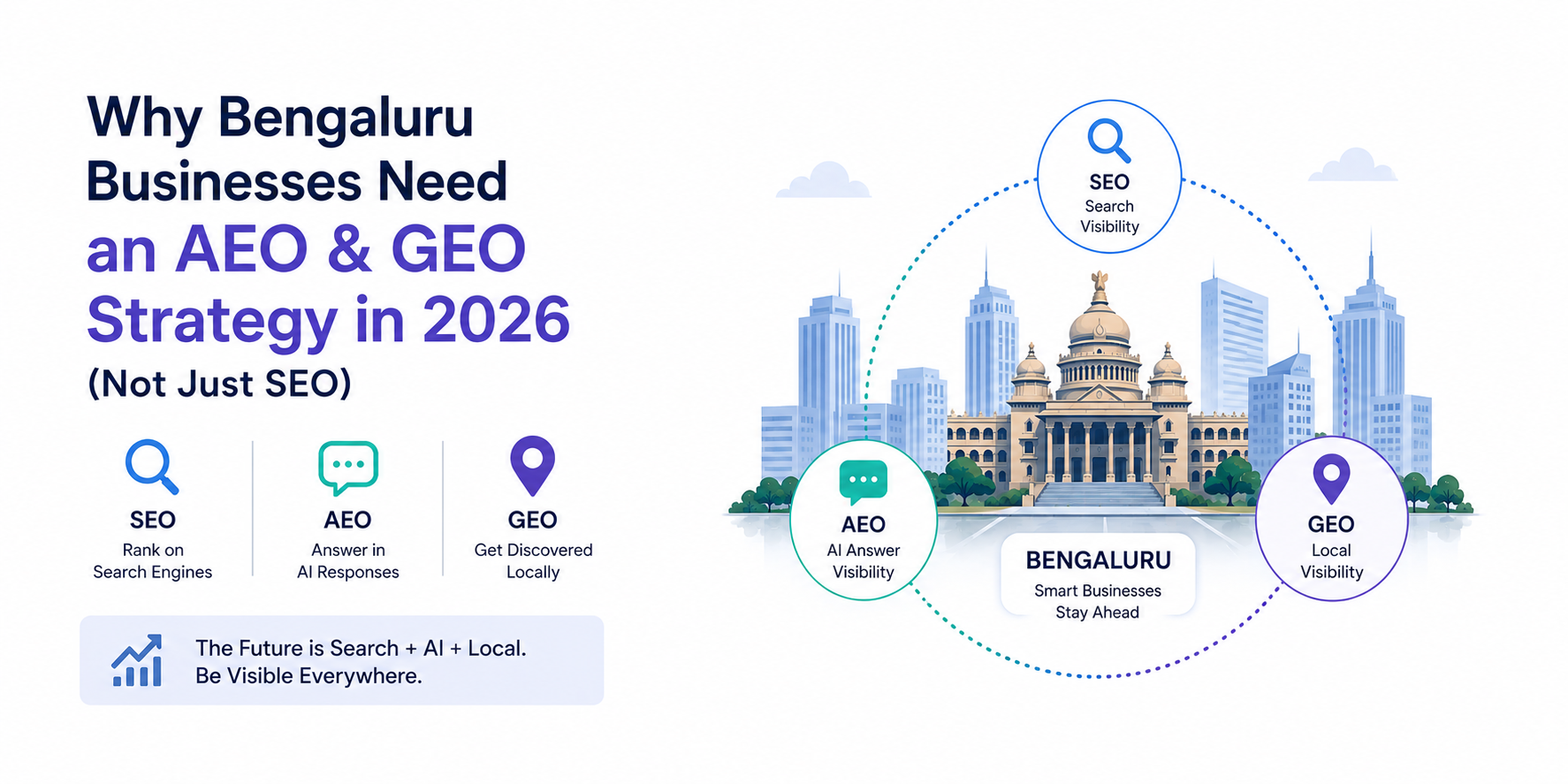
Search is changing faster than most business owners have noticed. A growing share of Google searches now get answered directly on the results page — through AI Overviews or AI Mode — before anyone clicks through to a website. If your marketing plan still stops at “rank on page one,” you’re already a step behind. Here’s what Answer Engine Optimization (AEO) and Generative Engine Optimization (GEO) actually mean, and what to do about them this month.
What AEO and GEO Actually Mean
The two terms get used interchangeably, but they’re solving slightly different problems. AEO is about getting your content picked as the direct answer shown inside search engines, voice assistants, and AI-powered search results — the box that appears before the usual list of links. GEO is about getting mentioned by name when someone asks a related question inside an AI chat tool like ChatGPT, Gemini, or Google’s AI Mode, even when they never visit a search engine at all.
Both replace the old goal of “earn a click” with a new one: “get cited.” That’s a real shift in how content needs to be written and structured, not just where it needs to rank.
A Real Example of How This Plays Out
Picture two interior designers in Bengaluru, both genuinely good at their work. One has a website that says “We provide premium interior design solutions tailored to your lifestyle.” The other has a page that says “We design 2 and 3 BHK apartment interiors in Bengaluru, typically completing a full home in 45–60 days, starting around a specific, clearly stated budget range.”
Ask an AI assistant “who does apartment interior design in Bengaluru within a set budget,” and the second designer has a real chance of being named. The first one doesn’t — not because their work is worse, but because there’s nothing specific in their content for the AI to extract and repeat. AI tools cite facts, not adjectives. “Premium,” “tailored,” and “world-class” are the words that get skipped over; numbers, locations, timelines, and plain descriptions are the words that get quoted.
Why This Matters for Bengaluru Businesses Right Now
People are increasingly asking AI tools questions like “best digital marketing freelancer in Bengaluru” or “which real estate project near me has the best amenities” instead of scrolling through ten blue links themselves. A business with a genuinely good product but vague, generic website copy simply doesn’t get mentioned in that answer — not because the AI tool is biased, but because it has nothing specific to cite.
Three things you can do this month
These aren’t abstract suggestions — each one is something you can finish in an afternoon.
- Write a short FAQ section answering the exact questions your customers actually ask, in plain, direct sentences — not “we offer a range of solutions,” but “yes, we work with budgets starting at ₹X” or “our typical turnaround is Y weeks.”
- Add structured data (schema markup) — Person, LocalBusiness, or FAQPage — so AI tools have clean, labeled facts to pull from instead of guessing from paragraphs of marketing copy. If you’re on WordPress with Rank Math, this is a checkbox and a few fields, not custom development.
- Keep your Google Business Profile complete and accurate — hours, category, services, and photos — since it’s one of the sources AI tools cross-reference most often for local businesses, often more than the website itself.
How to Actually Add Schema Markup, Without Hiring a Developer
Schema markup sounds technical, but for most small businesses it’s genuinely simple. If your site runs on Rank Math, there’s a Schema tab in the page or post editor where you pick a template (Person, LocalBusiness, Product, FAQ, and so on) and fill in fields — name, address, services, hours, price range. Rank Math generates the correct code in the background.
If you’re not on a plugin that does this automatically, a developer can add it directly as a small block of JSON-LD code in the page — usually under fifteen minutes of work once the facts are decided. The hard part isn’t the code; it’s deciding, in plain language, exactly what facts about your business you want an AI tool to be able to state confidently. Write that list first, and the markup becomes a formality.
Common Mistakes Businesses Make With AEO/GEO
- Writing vague brand language instead of specific facts. “Industry-leading” and “trusted by many” give an AI tool nothing to cite. A real number, name, or location does.
- Treating it as a one-time setup. AI tools re-crawl and re-index regularly. A FAQ section written once and never revisited stops reflecting your actual current offers, pricing, or service area.
- Ignoring the Google Business Profile. Many businesses optimize their website heavily and leave their Business Profile half-filled, even though it’s frequently the more-cited source for local queries.
- Adding schema markup with incorrect or outdated information. Structured data that contradicts what’s actually on the page can do more harm than having no schema at all.
How to Check If It’s Actually Working
You don’t need expensive tools to see whether this is paying off. Search Console’s structured data reports will tell you whether your schema markup is being read correctly and without errors. Beyond that, the simplest check is also the most direct one: periodically ask ChatGPT, Gemini, or Google yourself the exact questions you’d want a potential customer to ask — “who does [your service] in [your area]” — and see whether your business gets mentioned, and what gets said about it. If it’s not there yet, that gap is usually a content gap, not a technical one.
Is AEO/GEO replacing SEO?
No. Site speed, mobile-friendliness, backlinks, and genuinely useful content still matter, because AI tools and search engines are both still crawling and ranking the same underlying pages. AEO and GEO are an additional layer on top of solid SEO fundamentals, not a replacement for them — skipping the fundamentals to chase AI visibility usually backfires.
Not sure where you stand?I’ll take a look at how your business currently shows up in AI search results.
Book a callThe businesses that get ahead here won’t be the ones with the biggest budgets — they’ll be the ones who wrote their website like they were answering a real customer’s real question, instead of writing to please an algorithm. Smaller businesses in Bengaluru can actually move faster on this than large, slow-moving brands, precisely because a founder can rewrite a vague page into a specific one in a single afternoon. A large brand needs a committee to approve the same change.

Prakash Kingsoul
Digital marketing freelancer in Bengaluru, running website design, SEO, Google Ads, Meta Ads, and marketing automation for growing businesses — backed by a small dedicated team.